Enquire Now
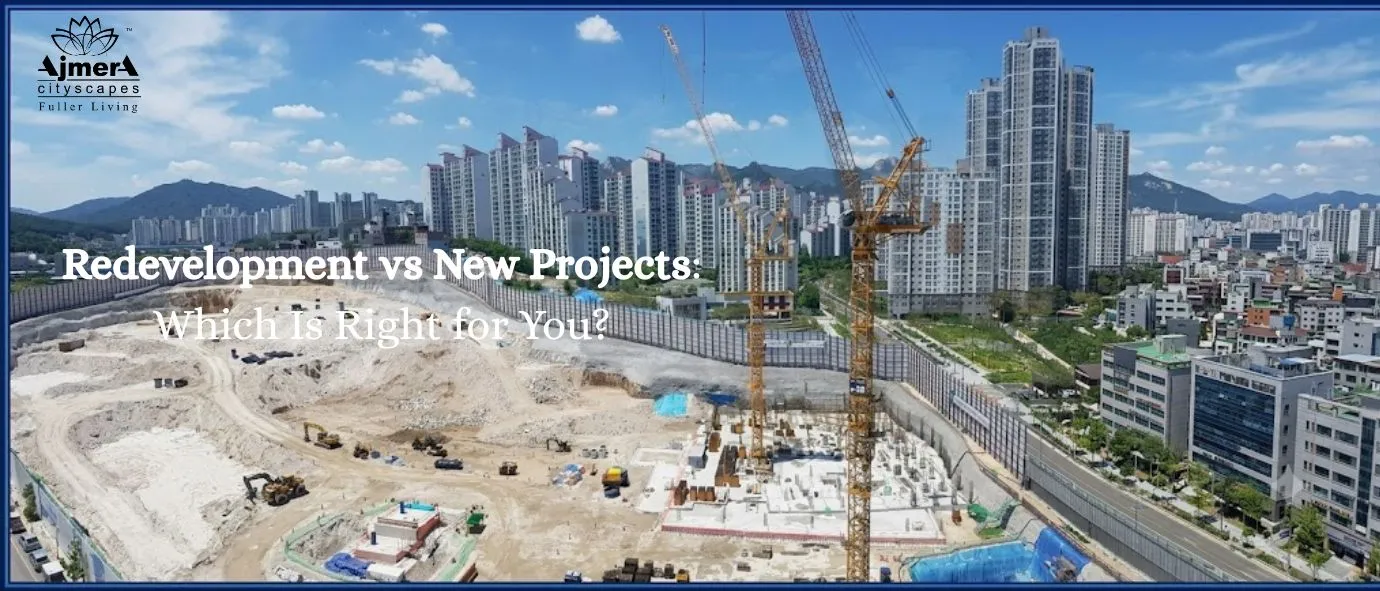
What looks like a new home may have two very different stories behind it. Buyers today come across two development models: real estate redevelopment and new projects. Both can deliver modern homes, better amenities and smarter use of land, but the journey from planning to possession is very different.
This guide explains how the two compare on location, approvals, timelines, benefits and risks, so you can evaluate any project with confidence.
In this guide: What redevelopment is, what a new project is, a side-by-side comparison, the redevelopment process, benefits of each, redevelopment vs reconstruction, a buyer's checklist and FAQs.
Real estate redevelopment means replacing, upgrading or rebuilding an existing property or building, rather than developing an unused site. It is commonly considered for ageing residential buildings, housing societies and properties whose structure or layout no longer meets current needs.
In a typical project, the existing structure is demolished and replaced with a new building featuring updated layouts, modern amenities and improved infrastructure. Existing occupants may receive new homes under agreed terms, depending on the project and applicable regulations.
A new project starts with a development site and builds a building or group of buildings from the ground up. Unlike redevelopment, there is generally no existing residential structure to replace.
This gives developers more flexibility to plan the building layout, apartment configurations, amenities, parking and common areas, within the project's development potential and applicable regulations. For buyers, that can mean contemporary floor plans, newer building systems and amenities designed around present-day lifestyles.
| Factor | Redevelopment | New Projects |
|---|---|---|
| Starting point | Existing property is replaced or substantially upgraded | Development starts on a new project site |
| Location | Often established neighbourhoods | Can be established or developing locations |
| Planning | Existing property and regulations influence planning | Greater flexibility from the beginning |
| Residents | Existing occupants may be part of the project | Usually purchased by new buyers |
| Construction | Demolition and rebuilding or major reconstruction | Starts from the foundation |
| Approvals | May involve additional redevelopment-related requirements | Follows approvals applicable to a new project |
| Timeline | Can depend on agreements, approvals and relocation | Depends on planning, approvals and construction |
| Main objective | Modernise existing property and improve its use | Create a completely new development |
The redevelopment process varies by property type, location and applicable regulations. For a housing society, it generally moves through these stages:
Structural assessment: Evaluate the existing building and decide whether redevelopment is appropriate.
Society decision: Members discuss and agree on the way forward.
Consultants and developer selection: Appoint professional consultants, then evaluate developers and their proposals.
Agreements: Finalise contractual terms.
Approvals: Obtain the necessary permissions.
Temporary relocation: Move residents during construction.
Demolition and construction: The developer carries out the build.
Handover: Residents receive their new homes.
This makes residential redevelopment more than simply replacing an old building. Legal, financial, technical and project-management considerations need attention throughout.
Modern buildings: Ageing structures are replaced with improved layouts, common spaces, safety features and infrastructure.
Better use of land: Established areas with few vacant plots can be put to more effective use.
Staying in your neighbourhood: Residents can get a new home without leaving an area they already know.
Urban renewal: Redevelopment has become an important part of urban development in land-constrained cities.
Successful redevelopment depends on clear agreements, necessary approvals, a reliable developer, adequate funding, good construction quality and realistic timelines.
Planned from day one: Projects can be designed around current housing preferences and modern infrastructure needs.
Contemporary features: Buyers may get modern layouts, planned amenities, new electrical and plumbing systems and dedicated parking.
More choice: Depending on the project's stage and available inventory, buyers may have a wider range of configurations.
The terms are often used interchangeably, but they can mean different things.Reconstruction generally means rebuilding an existing structure. Redevelopment has a broader scope: it may include rebuilding along with changes to the property's planning, use, configuration or development potential.
In practice, the exact scope of a project matters more than the label attached to it.
Execution quality matters in both models. Developers must balance planning, approvals, design, construction quality, infrastructure and the needs of future occupants.
Established developers such as Ajmera Cityscapes are part of Mumbai's broader real estate landscape. Projects like Ajmera Downtown, Ajmera Shringaar and Ajmera Boulevard reflect residential development in established urban areas and changing housing requirements.
Whichever project you consider, look beyond the name and examine location, connectivity, layout, approvals, amenities, construction quality and the developer's documented project history.
Location and connectivity:Check access to transport, schools, healthcare and daily needs.
Approvals and documentation:Confirm title, sanctioned plans and RERA registration (MahaRERA for projects in Maharashtra).
Developer track record: Review past projects, delivery history and construction quality.
Timeline: Look at the stated possession date and what it depends on, including approvals and, for redevelopment, relocation.
Specifications and amenities: Compare what is promised in writing across projects.
Legal agreements: Read the terms on possession, delays, maintenance and your rights as an occupant or buyer. Consider independent legal advice.
The key is to compare the actual project rather than assuming one model is automatically better.
There is no single answer for every buyer.
Redevelopment may suit you if you value an established neighbourhood with existing residential infrastructure and a property that needs modernising.
A new project may suit you if you want a newly planned development with contemporary layouts and amenities from the start.
The key is to compare the actual project rather than assuming one model is automatically better.
What is the main difference between redevelopment and a new project?
Redevelopment transforms an existing property, while a new project builds on a fresh site from the ground up.
Is redevelopment better than new construction?
Neither is automatically better. The right choice depends on the location, approvals, timeline, developer's track record and your own priorities.
Do redevelopment projects take longer?
Timelines can depend on society agreements, approvals and resident relocation. New projects depend on planning, approvals and construction. Always check the stated possession date and the conditions attached to it.
Is redevelopment the same as reconstruction?
Not always. Reconstruction generally means rebuilding an existing structure, while redevelopment can also involve changes to planning, use or development potential.
What should I check before buying in either type of project?
Location, approvals, RERA registration, developer track record, construction specifications, amenities and the legal documentation.
The difference between redevelopment and new construction mainly lies in the starting point and the development process. Redevelopment transforms an existing property; a new project builds from the ground up. Whichever you consider, compare location, approvals, construction quality, amenities, documentation and long-term suitability before making your decision.
Exploring homes in Mumbai? Explore Ajmera Cityscapes projects, or get in touch with our team to discuss which option fits your needs.